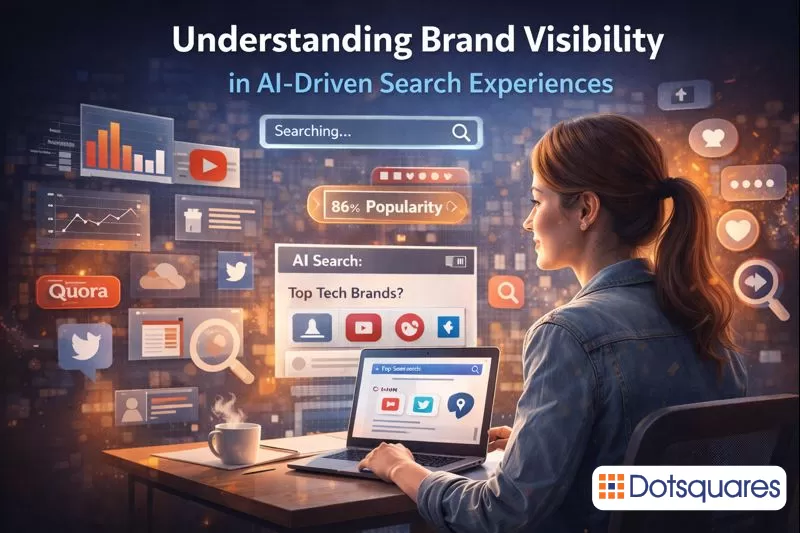
Search is changing faster than ever. For years, brand visibility meant ranking on Google’s first page. Today, users are increasingly turning to AI-powered experiences like ChatGPT, Google’s AI Mode, and AI Overviews to get direct answers, comparisons, and recommendations—often without clicking a single link.
This shift raises an important question for brands:
What actually influences whether your brand gets mentioned by AI?
Recent research into AI brand visibility reveals a clear pattern. Traditional SEO still matters, but AI systems prioritise brand presence, credibility, and real-world signals far more than keyword rankings alone. Study few key factors shaping brand visibility in AI-driven search and think what they mean for your marketing strategy.
1.Brand Presence Across the Web Beats Rankings Alone
One of the biggest takeaways from AI visibility analysis is simple:
AI mentions brands that already exist prominently across the web.
AI models don’t just rely on one website or a single ranking factor. They learn from a wide range of public content—articles, blogs, forums, videos, and brand discussions. If your brand is frequently mentioned across trusted platforms, AI systems are far more likely to recognise and reference it in responses.
This is why brand mentions have become more influential than traditional backlinks in many AI environments. It’s less about how many links point to you and more about how often your brand appears in meaningful, relevant contexts.
2.YouTube Visibility Plays a Major Role
Video content, especially on YouTube, has emerged as one of the strongest drivers of AI brand visibility.
Why? Because YouTube videos generate rich, indexable signals—titles, descriptions, transcripts, and engagement data. AI models use this information to understand brands, products, and expertise at scale.
Brands that consistently appear in YouTube content—whether through tutorials, reviews, interviews, or expert commentary—are significantly more likely to be referenced by AI systems. This applies not only to Google’s AI products but also to conversational platforms like ChatGPT.
One can say, if your brand doesn’t have the YouTube channel, you’re missing a major AI visibility opportunity.
3. Branded Search Demand Signals Trust
Another important factor influencing AI mentions is branded search volume—how often users actively search for your brand name.
When people search for a brand directly, it sends a strong signal of trust, awareness, and relevance. AI systems interpret this behaviour as evidence that a brand is recognised and valued by real users.
This is why AI visibility tends to favour brands with established demand. It’s also why performance marketing alone isn’t enough anymore. Brand-building activities—PR, thought leadership, social presence, and community engagement, play a growing role in AI SEO.
4. Authority Is About Context, Not Just Links
In traditional SEO, authority was often measured by domain rating or backlink volume. AI systems, however, take a broader and more nuanced view.
While links still matter, AI prioritises contextual authority—how your brand is discussed, where it appears, and what topics it’s consistently associated with. A smaller brand that is regularly mentioned in relevant discussions can outperform a larger site with generic backlinks.
Platforms like forums, Q&A sites, expert blogs, and industry publications contribute heavily to this contextual understanding. When your brand is part of expert conversations, AI is more likely to treat it as a reliable reference.
5. Different AI Platforms, Different Weightings
Not all AI platforms work the same way.
- Google’s AI Overviews tend to rely more on established web signals and brand authority, reflecting Google’s traditional emphasis on trust and consensus.
- AI Mode often favours brands with strong recognition and consistent digital footprints.
- ChatGPT, meanwhile, appears more flexible, sometimes referencing emerging brands if they are well-represented across diverse, high-quality sources.
What This Means for Modern SEO Strategies
To stay visible in AI-driven search experiences, brands need to rethink how they approach SEO:
- Move beyond keywords and focus on brand presence across platforms.
- Invest in content formats AI understands well, especially video and expert-led content.
- Earn mentions, not just links, through PR, partnerships, and thought leadership.
- Strengthen branded demand so users actively search for you by name.
- Track AI visibility as a new performance metric alongside rankings and traffic.
It’s important to note that AI search isn’t replacing SEO, it’s expanding it. Brands that adapt early will benefit from higher trust, stronger visibility, and increased influence in how AI answers user questions.
