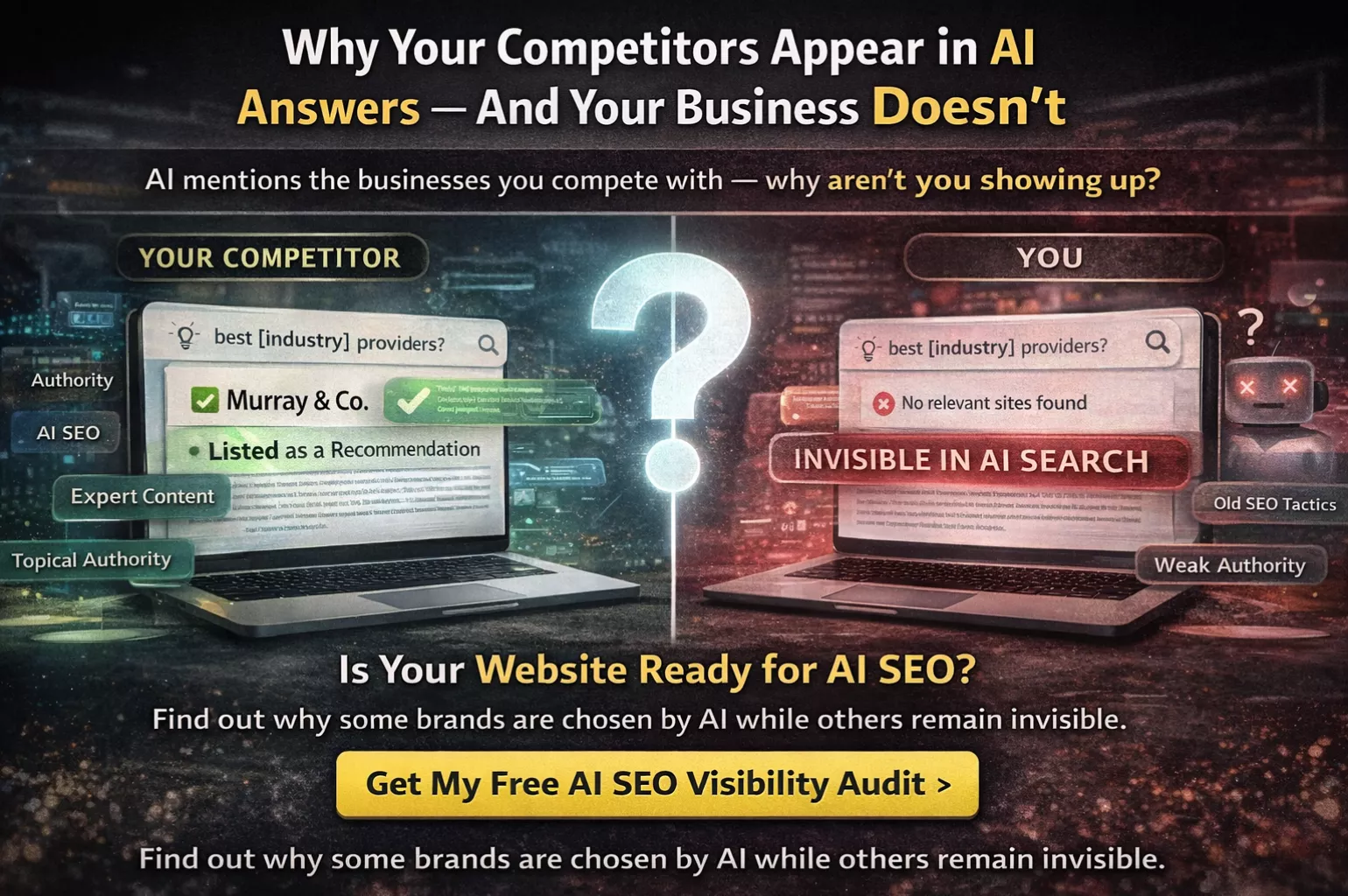
You search a question in ChatGPT, **Google AI results, or other AI-powered tools…
…and your competitors are mentioned as trusted solutions.
But your business? Nowhere.
Even if:
- Your website looks better
- You have more experience
- You already invested in SEO
- You rank on Google
This happens because AI platforms don’t rank websites the way traditional SEO does.
You don’t just have an SEO problem anymore.
You have an AI SEO visibility gap.
AI Platforms Don’t “Search” — They Select
Traditional SEO is about ranking pages in search engines.
AI SEO, however, is about making your content understandable, trustworthy, and extractable for AI systems.
AI systems:
- Analyze context, not just keywords
- Look for topical authority
- Prefer clear, structured explanations
- Pull from sources that appear consistent and credible
- Your competitor isn’t necessarily better at SEO.
They are simply easier for AI to interpret, trust, and reference — which is the foundation of AI SEO.
7 Reasons AI Mentions Your Competitors — Not You
Your Content Is Built for SEO Keywords, Not Answers
Traditional SEO focuses on keyword placement.
AI SEO focuses on clear answers to real questions.
If your pages are sales-heavy but explanation-light, AI skips you.
Your Website Lacks Topic Depth
SEO might rank a single service page.
AI SEO rewards topical authority.
Example:
One “Digital Marketing Services” page = basic SEO
A full content cluster on SEO, AI SEO, content strategy, and analytics = strong AI authority
You Don’t Use AI-Friendly Structure
AI systems understand structured SEO content like:
- Headings
- Lists
- Definitions
- Step-by-step explanations
Walls of text hurt both SEO readability and AI SEO extraction.
Your Competitors Teach. You Only Sell.
Educational content strengthens both SEO rankings and AI SEO visibility.
When competitors publish:
- Industry guides
- Frameworks
- How-to resources
They become trusted sources for AI platforms.
Weak Semantic Relevance
Modern SEO already values semantic relevance.
AI SEO goes deeper — AI evaluates:
- Related concepts
- Contextual meaning
- Topic coverage
If your content only repeats keywords without depth, AI sees low expertise.
Your Brand Has Low Digital Authority Signals
SEO considers backlinks and domain authority.
AI SEO also considers brand presence, consistency, and expertise signals across the web.
Brands that publish expert content regularly become more “citable” in AI answers.
Your Content Isn’t “Answer-Ready”
AI tools prioritize SEO content formatted like:
- What is X?
- How does X work?
- Best ways to do X
If your website lacks this structure, your SEO might work — but your AI SEO visibility suffers.
The Big Truth
Ranking on Google through SEO ≠ appearing in AI answers.
Your competitors are optimizing for both SEO and AI SEO.
Most businesses are still optimizing for search engines alone.
That’s the gap.
The New Advantage: AI SEO Optimization
To compete in AI-driven search, businesses now need:
- AI-friendly content structure
- Topical authority clusters
- Semantic SEO optimization
- Answer-focused formatting
- Expert educational resources
This is the next evolution of SEO.
Is Your Website Ready for AI SEO?
Many websites perform well in traditional SEO but remain invisible in AI-driven platforms.
They:
- Rank for keywords
- Look good visually
- Convert visitors
…but lack AI SEO foundations that make them discoverable in AI answers.
Get a Free AI SEO Visibility Audit
We’ll analyze:
- Whether AI can understand your services
- If your SEO content shows topical authority
- Where competitors outperform you
- What prevents your brand from appearing in AI answers
Stop investing in SEO alone while competitors win with AI SEO.
Start with a Free AI SEO Visibility Audit and uncover the gaps holding your business back.
